Booking System for a Tourism Business in Eilat: Platform, Off the Shelf Software, or a System Built for the Business
A tourism business in Eilat has three ways to take bookings. An external platform that brings customers and takes a commission. Off the shelf software you pay a subscription for and adapt your work to. Or a system built around the business itself. We built the third way for a water sports beach, for a park and for vacation villa management, and this article explains what we learned from each one. When each way is right, and what a system that works through an Eilat season must have.
Why bookings are a different problem for a tourism business in Eilat
A booking at a water sports beach is nothing like a haircut appointment. There is a round that leaves at a set time with a fixed number of seats. There is weather that can cancel the whole day. Some customers booked in advance and some just walked up to the desk and want the next round. And there is a season when the desk never stops answering the phone, and months with almost no traffic. We collected the seasonality numbers on the Eilat tourism numbers page, and what to do with it in the article on when to advertise a business in Eilat.
The systems we build were born from this reality. A water sports beach in Eilat we work with came to us with a desk that wrote on paper and a phone that never stopped. A family park came with attractions that need inspections and team coordination. And a vacation villa management company came with bookings coming in from three different places that did not talk to each other. Three businesses, three kinds of booking, and the same problem underneath. No off the shelf tool understood how they actually work.
Three ways to take bookings and what each one gives you
The difference between the three is not just money. It is who holds the customer and who decides how the business works.
An external platform is a site that sells experiences or stays and brings in customers who are searching in Eilat. It brings traffic that would not have arrived on its own, and that is its big advantage. The price is a commission on every booking, and a customer who stays the platform's customer. Their details sit with the platform and the next marketing message reaches them through it too. Off the shelf software is a ready made system you pay a monthly subscription for. It is quick to set up and fits a business whose process looks like what the software already knows. The trouble starts when the business works differently from what the software assumed. Then you start bending the work to fit the tool. A system built for the business is the opposite. The tool adapts itself to how the business works. It takes scoping and an investment up front, and the result is a team that works the way it is used to, just without paper and without a phone that never stops.
| What you compare | External platform | Off the shelf software | System built for the business |
|---|---|---|---|
| How you pay | A commission on every booking, at the platform's quoted rate | A monthly subscription by number of users or bookings | A setup cost and then maintenance. No commission per booking |
| Who holds the customer | The platform. The details and the next contact stay with it | The business, but inside the software's structure | The business. Everything is theirs and can be exported |
| Flexibility for the season | Low. The platform's rules are fixed | Medium. Whatever the software allows | Full. Rounds, prices and hours change on your call |
| Weather cancellations | By the platform's policy | By what the software knows. Not always there | Built in from the start. Cancel a whole round and message everyone in one click |
| Desk and online together | No. The platform only sees its own | Depends on the software | One screen. Whoever booked ahead and whoever just walked up sit on the same list |
| Languages | Whatever the platform offers | Usually English, sometimes Hebrew | Hebrew and English from day one, and more languages as needed |
| Connection to Google and ads | The platform gets promoted. Not the business | Sometimes through a plugin | A booking button on the Google Business Profile and conversion tracking in the campaign |
| Who it fits | A new business that wants traffic now and is willing to pay for it | A business with a standard process | A business with a process of its own that wants to hold the customer |
What we learned from a water sports beach: rounds, the desk and the weather
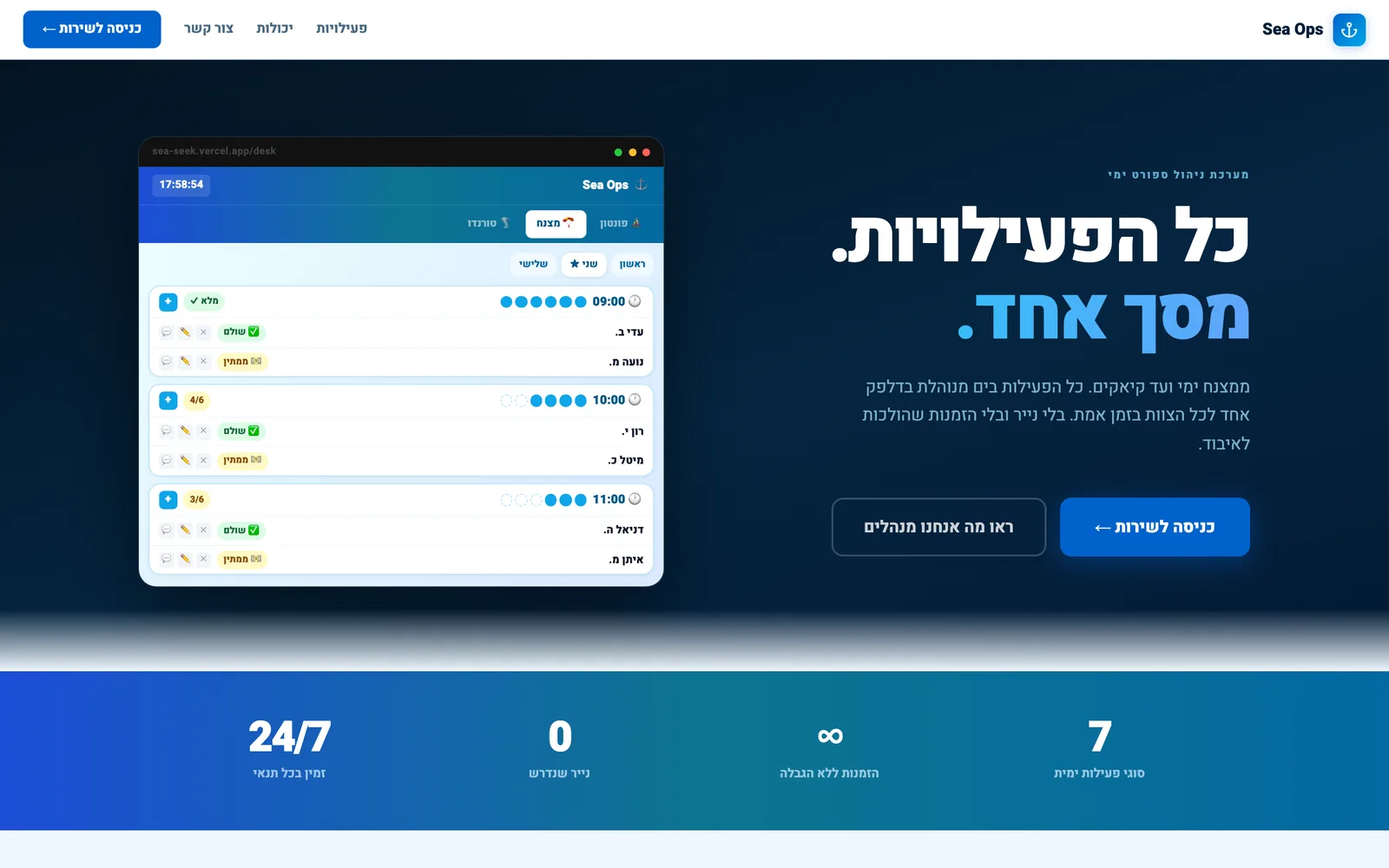
The first thing a water sports beach needs is rounds. A banana boat that leaves at ten thirty with eight seats. A tube ride at eleven with six. The system has to show the desk, at any moment, how many seats are left on each round, and let them open a booking in seconds while the customer is standing right there. Whoever booked ahead on the site and whoever just arrived at the beach sit on the same list. Otherwise seats get sold twice.
The second thing is the guides out on the water. They need to see from their phone the same picture the desk sees. Who is getting on the next boat and who already paid. No paper running between the desk and the beach. The third thing is weather. A strong wind closes the sea for hours. In the system we built you cancel a whole round in one click and everyone booked on it gets a message. Then you offer them another round or a refund. Without that, the desk spends the morning on the phone.
And the fourth thing is the seasonal team. In summer the beach runs on people who came for three months. The system has to be simple enough that a new guide learns it on day one. Clear roles. The desk sees everything. The guide sees their own round. The owner sees the numbers.
What we learned from a park: attractions, inspections and a team in the field
A family park is a different story. There the problem is not just the booking but the operations around it. Every attraction has periodic inspections that must happen. There are faults that come up in the middle of the day. And there is a team out in the field next to the attraction, not in front of a computer.
The system we built for the park gives every attraction a card with its history. Periodic inspections come up on the calendar on their own and whoever is responsible gets a reminder. A worker who spots a fault photographs it from their phone and it goes onto the board by urgency. The manager sees what was fixed, what is waiting and what keeps coming back. It sounds far from bookings but it is the same principle. The system adapts itself to how the team actually works. From the phone in the field, not from an office.
What we learned from villa management: bookings arriving from several places at once
Vacation villa management is the most complex case we have met. One villa is listed on several channels at the same time. The big booking site. The home stay site. And the business's own site. Every channel brings bookings, and if they do not talk to each other the same night gets sold twice. That is every property manager's nightmare.
The system we built for a villa management company syncs the calendar against those channels. A booking that comes in on one closes the date on all of them. From there everything runs on its own. The guest gets a WhatsApp message before arrival. Signs the contract from their phone. Pays through a link. The team gets cleaning and prep tasks for the right day. And the owner sees income and expenses on one screen. Villa Vibes, who we work with, manages properties in Eilat and the area this way.
The lesson from this case matters for every tourism business. The more booking channels you have, the higher the chance of a manual mistake. The answer is not to give up channels but to connect them to one place that is the single source of truth.
What every booking system for a business in Eilat must have

After three different systems there is a list that repeats in all of them. These are the things without which the system will not last a season.
- Real time availability. Whoever books on the site and whoever stands at the desk see the same open seats at the same second
- Hebrew and English from day one. A tourist books in English, the desk works in Hebrew, and both see the same booking
- Phone first. The desk, the guide and the manager work from their phones, not from a computer. The screen has to be fast and clear on a small display
- WhatsApp confirmation. The customer gets a confirmation and the reminder arrives on its own. That cuts no shows without anyone making a call
- Group cancellation. The option to cancel a round or a whole day and notify everyone in one click. Eilat weather does not ask
- Simple roles. A seasonal worker learns their screen on day one and does not see what is not theirs
- A deposit or payment up front. It cuts no shows in the busy season and gives the business certainty
- The customer stays with the business. The details live in the business's system and can be exported. Not locked up with anyone
- Connection to the Google Business Profile and to ads. A booking button right from the map, and tracking how many bookings each campaign brought
How to connect the system to Google and to ads
A booking system that stands alone does half the job. The other half is connecting it to the places where the customer searches. The Google Business Profile lets you add a booking button that shows up right on the map. A tourist searching for water sports near me sees the business and books without ever visiting the site. We explained how to set up the profile in the article on the Google Business Profile for a business in Eilat.
The second thing is conversion tracking. When you run a Google campaign you need to know how many bookings came from it and what each one cost. The system sends Google a signal on every completed booking, and then you see in the ads account what actually worked. Without that you manage a budget by gut feeling. We explained how to build the campaign itself in the article on Google Ads for a business in Eilat.
When you do not need a custom system
Let us say this honestly because it is true. A business with a simple process does not need to build a system. A restaurant that wants table reservations. A hair salon that wants an appointment book. There, off the shelf software does the job well, fast and cheap. A new business that does not yet know how it works is also better off starting with a platform or existing software, and learning what it is missing before it invests.
A custom system is right when there is a process no tool understands. Rounds with seats. Booking channels that need to sync. A team in the field working from phones. Or simply a business that has grown and feels it is working for the software instead of the software working for it. Then you sit down for scoping and start with a prototype. A first live version you can click through within weeks, and then decide whether to continue. How that works with us is on the app and system development page.
Sources and verification
This article is based on work we actually did, not on a market survey. The three systems described in it were built by us and run today at businesses in Eilat and the area. We did not write numbers for platform commissions or off the shelf pricing because they change and you can only get them in a direct quote. What we wrote about Google was checked against the official help center.
- Our own work. A desk and booking system for a water sports beach in Eilat. A maintenance system for a park. A vacation villa management system with channel sync
- Google. The Google Business Profile help center on booking buttons
- Google. The Google Ads help center on conversion tracking
- The Israel Central Bureau of Statistics (CBS). The Eilat seasonality figures shown on our numbers page
This is exactly what we do at App and System Development. If you want us to go over it together for your business, write to us.
Frequently asked questions
It depends on scope, exactly like a website. The difference is that you start with a small, relatively cheap prototype and decide to continue only after you see it working. That way you do not commit to a big sum on day one. In the scoping call you get a timeline and a price based on what the business actually needs.
You do not have to choose. Many businesses stay on a platform for the traffic it brings and hold a system of their own for the customers who come directly. What matters is that there is one calendar, and that a booking from the platform closes the spot with you too.
In the system we built for the beach you cancel a whole round in one click and everyone booked on it gets an automatic message. Then you offer them another round or a refund. Without that, the desk spends the morning on the phone instead of taking care of the customers who did show up.
Usually a website that works well on the phone and installs on the home screen like an app is enough. The team opens it from their phones and the customer books from it. A real app in the store makes sense when you need notifications or work without reception, and that is rare in a tourism business in Eilat.
A first prototype you can click through shows up within weeks. A full system that runs through a season depends on scope. We built the beach and the park in stages, and the team worked with the system before it was finished and steered us along the way.
Only if you feel you are working for the software. If the team bends the work to fit the tool, or if there is a process the software simply cannot do. If it does the job, there is no reason to touch it.
Want us to look at this for your business?
Just write to us on WhatsApp. The first conversation comes with no commitment. 050-294-0127
Write to us on WhatsApp